 NextMars
Frame-by-frame animation draws every pose as a separate image, while rigged animation moves one set of layered body parts with a skeleton and keyframes. Both produce 2D animation, but they are different production systems: one buys freedom of drawing, the other buys repeatability.
Teams often choose between them on looks alone. That works until the character list grows, the state machine doubles, or the marketing team asks for one more pose on a Friday. The method you pick decides what is cheap to change later — and in a live game, most of the cost lives in changes, not in the first animation.
NextMars is a London 2D studio producing concept art, characters, environments, UI, Spine animation and frame-by-frame animation for games, film and publishing. We use both methods and hand over both kinds of file. This is how we decide which one fits a project.
What is the actual difference between the two methods?
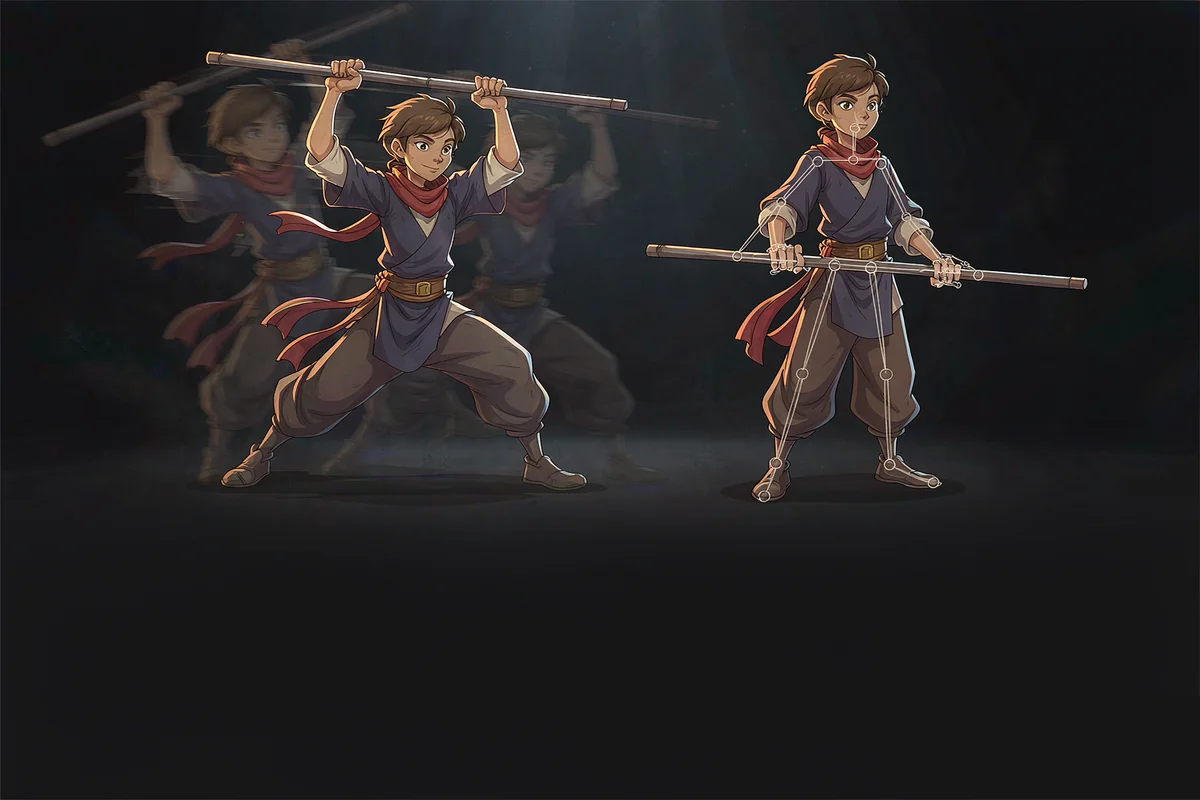
In frame-by-frame work, the animator draws a sequence of poses. Each frame is a new piece of art, so the shape of the body, the silhouette and the line weight can all change from one frame to the next. That is why it is the natural choice for squash and stretch, explosive effects and any motion where the body itself deforms.
In rigged work — Spine being the common tool for games — the character is drawn once as separated parts and then moved by a skeleton. The drawings stay fixed; the joints carry the motion. Changing an animation later means moving keys, not redrawing frames. It is less forgiving of extreme deformation, but far easier to extend.
Neither is more professional. They are answers to different questions: do you need the drawing to change, or do you need the change to be cheap?
| Question | Frame-by-frame | Fully rigged |
|---|---|---|
| Best fit | Effects, impact poses, short expressive loops | Long state lists, many characters, frequent edits |
| Main cost driver | Number of unique drawings | Number of parts and rig complexity |
| Changing one frame later | Redraw and re-check neighbours | Move keys, no redraw |
| Consistency across a batch | Depends on the animator's hand | Built into the shared rig |
| Handover | Ordered frames, sheet or sequence | Project file, skeleton, skins and export settings |
Which method survives a long character list?
Rigged animation usually does. If a game has twelve characters with idle, walk, run, attack, hit and death states, rigging means the states are variations on one setup. A new animation is another animation clip, not another set of drawings.
Frame-by-frame can still be right for that project, but only for a smaller slice of it. A common pattern is to rig the characters for locomotion and draw the big impact moments by hand. The two outputs can live side by side in the same game, and they often do.
The decision should be made per asset type, not once for the whole studio. Marketing art, trailers and short dramatic beats are where hand-drawn frames earn their keep; routine gameplay states are where rigs pay for themselves.
How does the review loop differ?
With frame-by-frame, review is visual: does the motion read, does the timing land, does the silhouette hold from frame to frame? Notes are about drawing. A client can point at a single frame and say it looks wrong, and the fix is local.
With rigged animation, review is structural. The first approval is the cut-up and the rig — the drawing split into parts and the skeleton placed under it. If that foundation is approved too quickly, every later clip inherits the mistake. We always ask for a movement test on the rig before we build out the state list, because fixing a joint placement after twenty clips is a rebuild, not a tweak.
This is the part that surprises teams moving from illustration to animation: the drawing can be beautiful and the rig can still be wrong.
What files do you actually receive?
For frame-by-frame work, you should receive the ordered frames as a sheet or a numbered sequence, the layered source files, and a note on frame rate and loop points. If the frames are trimmed, you also need the original offsets — otherwise the pivot moves.
For rigged work, ask for the editable project file, not just the exported atlas. Without the project file you cannot retime a clip, adjust a mesh or add a skin. Ask which Spine version was used, because a file from a newer version may not open in an older one. In our sprite sheet guide we cover the export rules that apply when rigged animations are baked back down to frames.
A useful test for any vendor is to ask for a file they made two years ago and open it. If it opens and the rig still moves, you are dealing with someone who treats source files as part of the deliverable.
When does a hybrid make sense?
Most games of any size end up with a hybrid, whether they planned it or not. The clean version is deliberate: rig the character for the states that repeat, draw the states that carry personality.
A hybrid needs one rule to stay healthy — the hand-drawn frames must share the rig's scale, pivot and silhouette logic. If they do not, the character will look like two different characters in the same game. We set that rule on the reference sheet before either method starts, and we check it again when the two sets of files meet in the engine.
If your project is a short narrative piece with few repeated states, full frame-by-frame may be simpler and cheaper than maintaining a rig. If it is a live service with a content calendar, a rig will save you every month after launch.
How do you brief either method?
Five lines are enough: the character and its state list, the target platform, the maximum number of unique frames or clips you can carry, the engine, and whether you need the editable source. If you do not know which method you need, say so and describe the motion instead — we will recommend one and explain why.
Do not start with "we want it to look like this game". A reference sets the visual target, but it does not tell anyone whether the shoulders are separate parts or redrawn poses. That decision has to be made before a price means anything. Our guide to choosing a studio covers the questions that expose a vendor who has not made it; what moves a quote covers why the answer changes the scope.
How we work
We pick the method per asset, write the pivot and scale rules into the scope, and deliver editable sources with every animation. If a project starts frame-by-frame and later needs a rig, we rebuild the character as a rig rather than trying to convert frames — the result is cleaner and easier to maintain. You can see the disciplines we cover on our services page.
Send the five lines above and we will come back with a scope, a price and a date within 48 hours. If the method is the thing you are unsure about, send the motion description and we will tell you which one to use before you commit to either.