 NextMars
Two studios quote the same character. One number is several times the other. Neither is lying, and neither is necessarily the wrong choice. The gap is not quality — it is a different definition of the word "character", and a different assumption about how many times you will ask for a change.
Let me be straight about one thing before we go further: there is no honest public price list for this work, including ours. Anyone who prints "a 2D character costs X" is printing the price of one specific definition of a character, for one specific client, at one specific seniority, in one month of one year. It is a real number that has almost nothing to do with your project.
What can be explained is how the number gets built. Game art outsourcing is priced per defined deliverable, not per hour or per head — which is why the same three words on two purchase orders can differ by several times and both numbers still be correct.
Why the same asset attracts a five-fold spread
"A 2D character" describes at least three different jobs, and they are not close in cost.
| What you ask for | What arrives | Where it belongs |
|---|---|---|
| One drawing | A single illustration. No turnaround, no variants, no cut layers. | A pitch deck, a key visual, a mood frame |
| A design | Silhouettes, a few directions explored, one refined and approved | Pre-production, before the pipeline exists |
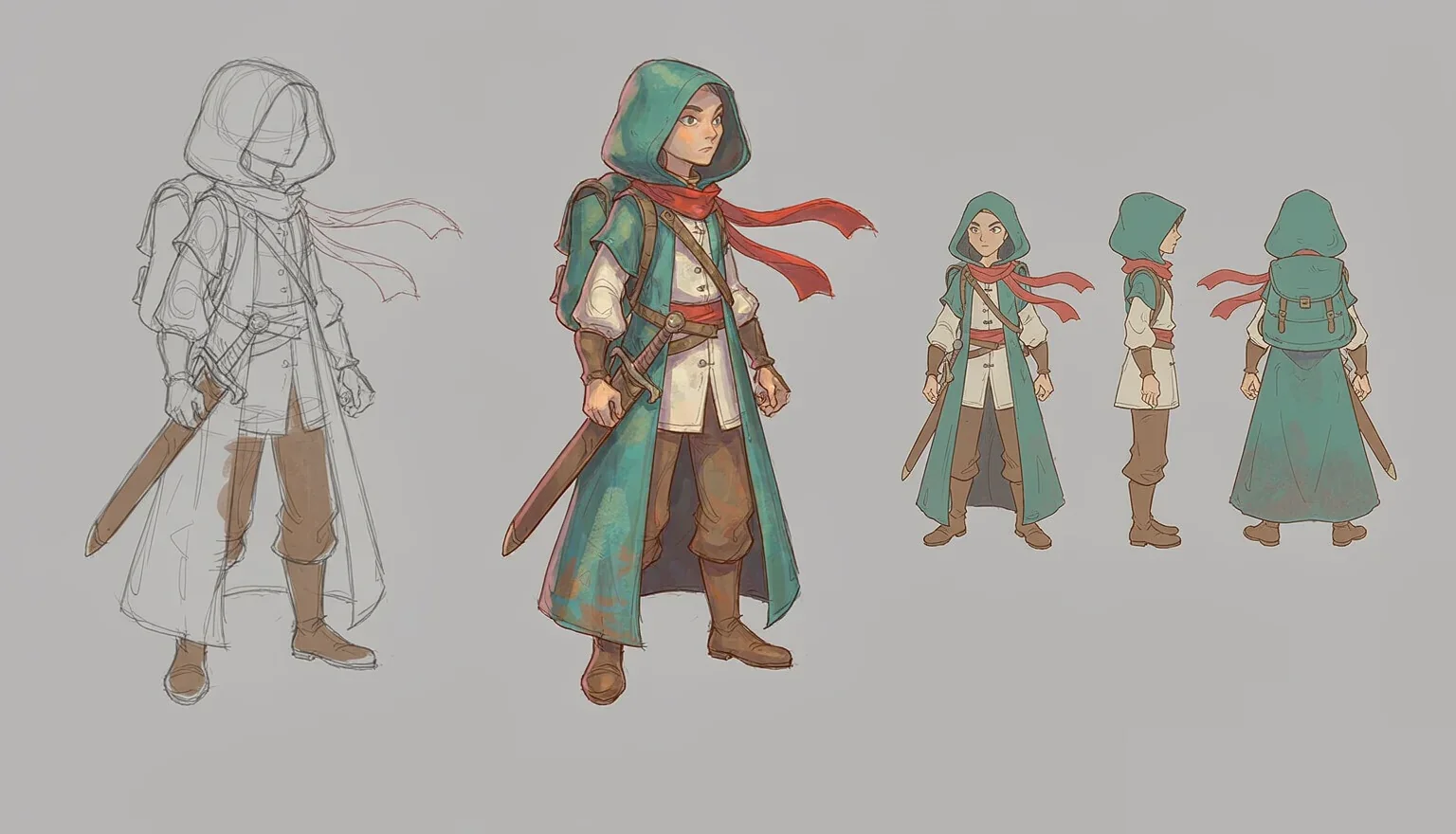
| A production asset | The approved design plus turnaround, expression sheet, pose sheet, cut layers ready to animate | Anything that has to ship |
Same three words on the purchase order. The last row is routinely several times the first, and nobody has been overcharged.
Which row you need is decided by what happens after delivery. Concept for a pitch is row one. Concept that an artist will build the final art from is row three, because the person building it needs to know what the back of the character looks like, and inventing it costs more than drawing it. If a quote makes no sense to you, this table is usually the explanation.
Every quote is hours, whatever the invoice calls it
An art quote is an estimate of hours multiplied by a rate, plus a buffer for the risk the studio is taking on your scope. A fixed price is not a different economic model — it is a bet that the scope will not move.
Two consequences follow, and both matter more than the headline number.
A much cheaper quote is usually the same hours at a lower rate, or fewer hours. If it comes from the same studio, it is fewer hours: fewer revision rounds, a less senior artist, or a scope definition that quietly leaves the turnaround out. Any of those is a legitimate choice. Not knowing which one you chose is the problem.
The buffer is where the honesty lives. A studio quoting with no risk buffer will either deliver late or bill you for the difference. One that quotes comfortably above its own arithmetic has done this before and is telling you so.
The five things that set the number
Not all of these weigh the same. The first two decide most of the spread between two quotes for "the same" work; the rest adjust it.
1. How finished the art direction is
An approved style, a reference board and a locked palette cut production time. "Make it look like this game but darker" does not. The difference between a client who sends twelve organised references and one who sends a Pinterest board is a large slice of the quote, and neither is being charged for the references themselves.
2. Revision rounds, and who counts them
"Two rounds per asset" only means something if a round is defined. A round is one consolidated set of notes delivered at once. Five separate emails with one note each is five rounds, and the studio will price the risk of that happening even if it never does.
Write it down: two rounds per stage, feedback consolidated in one document, an agreed number of working days to respond.
3. Volume and batching
A single unique character costs more per unit than the fifteenth character in a set, because the style, the palette and the rules are already established by then. Long runs are normally priced more cheaply per unit, and it is not generosity — it is real time saved.
The inverse catches people out: splitting one large job into four small jobs costs more than the same work in one run, because every restart pays the setup cost again.
4. Technical specification
Canvas size, aspect ratios, colour space, naming convention, engine target, pivot points, whether it needs to be cut for Spine, whether parallax layers must arrive as separate files. Every missing line gets estimated conservatively by the studio, then fixed later as either a change order or rework.
5. Who actually holds the pencil
A quote from a studio assumes a seniority mix. If the artist who made the portfolio piece you liked is not on your project, you bought a different product. This is legitimate to ask about, and good studios answer plainly.
What is not on the quote
These are the lines that turn an estimate into an invoice nobody expected. None of them are tricks; they are simply outside the per-asset price.
- Project management. Someone coordinates, chases and reports. Studios that do not charge for it are absorbing it somewhere else in the number.
- Engine integration. Importing, material setup, checking scale and pivots, fixing what breaks in Unity but not in the art tool.
- Rounds beyond the contracted number. Normally billed by the hour, and normally the largest single overrun on a project.
- Resizes and re-cuts. An icon set built for one build that now needs twice the resolution is new work, not an export.
- Localisation variants. Text baked into UI art multiplies per language. Text kept on a separate layer avoids the entire problem — ask for it at brief stage.
- Re-briefing when the brief changes. Mid-production direction changes are priced as new work, correctly.
Budget a margin above the raw asset total for these. Projects that skip that margin run over, almost without exception.
Two shapes of scope
Numbers are more useful as shapes than as totals. These are the two we quote most often.
A small indie scope. Eight 2D characters taken to production-ready, plus four single-screen backgrounds. Two artists, six to eight weeks. The interesting part is not the total — it is that the integration and extra review line is a visible share of it, and it is the line people forget when they compare two quotes side by side.
A mid-size content drop. Forty props and environment pieces, six animated characters with a shared rig and a few clips each. Larger team, longer calendar, and the same trap: the per-asset price looks comparable to the indie job, the total does not, because the review cycle and the integration work scale with the count.
So how do you find out what yours costs?
You send the scope. Not a call — a page of writing. What comes back is a definition of the deliverable, a price and a date, and all three hold because the assumptions are written down next to them.
That is the only version of this answer that is worth anything, for you or for us. A number published on a website is either too high, in which case you leave, or too low, in which case we argue about it in week three.
How to read a quote
A quote you can actually compare has five parts. If one is missing, ask for it before you decide anything.
- Deliverable definition. What exactly arrives, in which files, at what size, cut how.
- Stage breakdown. Concept, revision, final, per stage, with the number of rounds at each.
- Assumptions. The list of things the price depends on being true.
- Exclusions. Integration, localisation, extra formats, resizes.
- Who. Named art director, team size, and whether that team is dedicated to you.
Two quotes missing these five parts are not comparable, no matter what the totals say.
What to send to get a number that holds
At minimum: the asset list with counts, the art style reference, target platform and engine, resolution and technical constraints, the deadline, and whether you need animation-ready files.
Send us the brief and you will have a scope, a price and a date within one working day. If you are still deciding who to send it to, read how to choose a studio first; it will save you a round of quotes.